

Sector
Government & defense
We've delivered critical-infrastructure analysis for the Cybersecurity and Infrastructure Security Agency (CISA) as a subcontractor since 2018. We also train federal and defense analysts, and we build and publish data tools of our own.
UEI X563TN1QGJF1CAGE 9JFF2NAICS 541519 (primary)Self-certified Small Disadvantaged Business
§ 01 — delivered work
The CISA engagement.
For CISA, at the Department of Homeland Security (DHS), we model how natural disasters affect critical assets and the regional economies that depend on them. The enabling step is linking and de-duplicating critical-infrastructure records across federal and commercial datasets that share no common identifier. The work is delivered as a cloud-based geographic information system (GIS) analytics platform — interactive maps, sector and region filtering, reporting — with full system documentation, and has run continuously since 2018, as a subcontractor throughout.
We have also written and delivered AI and data-science curriculum for DHS and Department of Defense (DoD) analysts; the two published courses are further down this page.
§ 02 — public tools
7 federal data tools, three shown here.
Built from public records — one, Airthread, from synthetic scenarios — with no client data and nothing privileged. We built them because these questions are hard to answer any other way, and answering them is the capability we sell. Open one, check the sources, and export the underlying rows.
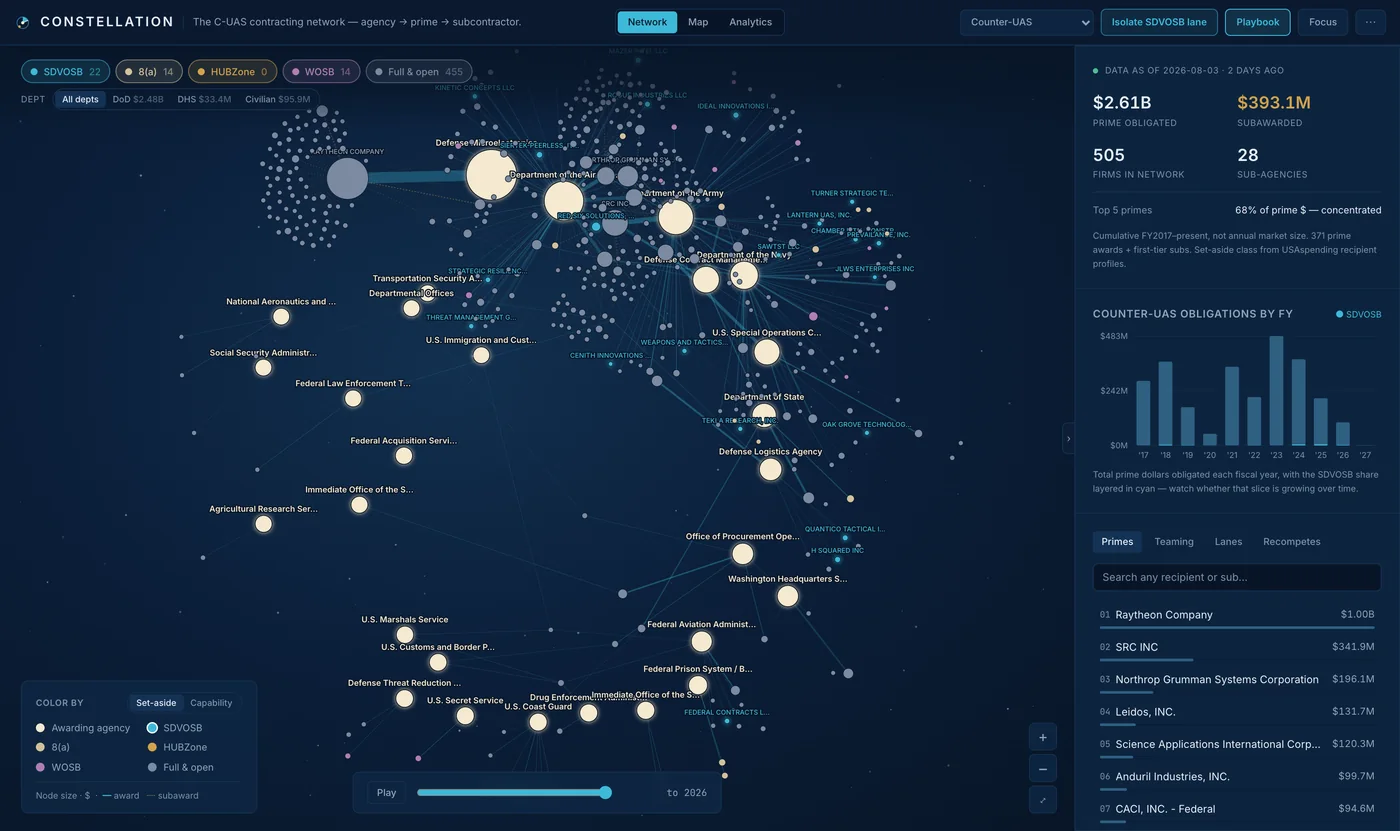 ConstellationFederal contracting networks, five marketsFive federal contracting markets — Counter-UAS, cybersecurity, AI and machine learning, space and satellite, and health IT — drawn live from federal spending records as agency, prime and subcontractor networks, with the small-business set-aside lanes broken out.Open
 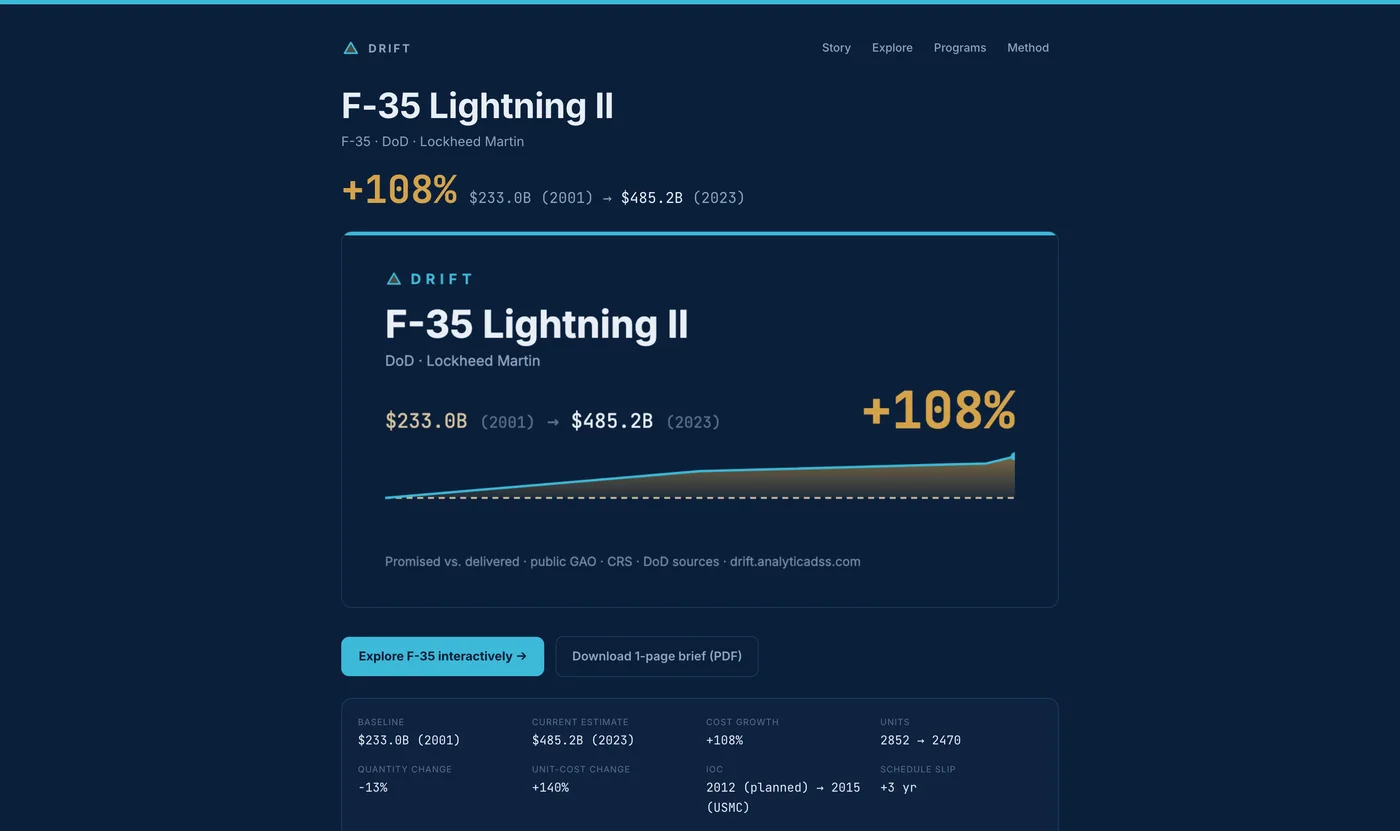 DriftMDAP cost growth explorerMajor defense acquisition programs, and the distance between what they were promised to cost and what they cost now. 56 verified programs, $1.3T baselined against $1.7T estimated, from GAO, CRS and DoD sources.Open
 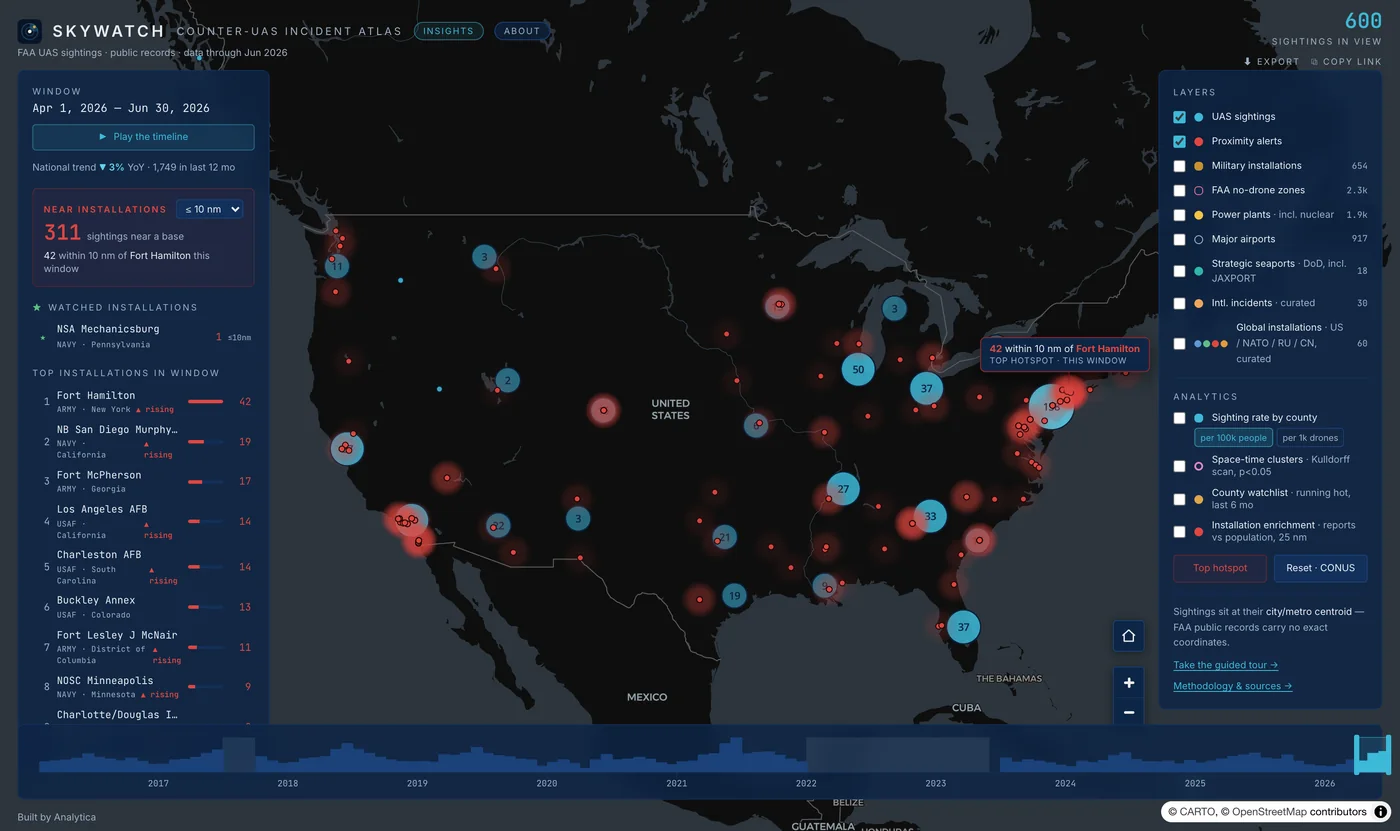 SkywatchCounter-UAS incident atlasEvery FAA drone sighting mapped against US critical infrastructure, with proximity alerts, per-county risk scoring and a 12-month timeline you can play.Open
§ 03 — what it demonstrates
What these tools demonstrate.
- Procurement mechanics
- Set-aside lanes, prime and first-tier subaward structure, the Federal Funding Accountability and Transparency Act (FFATA) reporting ceiling, recompete timing, and where service-disabled veteran-owned (SDVOSB) and 8(a) small businesses sit in a market.
- Acquisition behavior
- Program cost growth against baseline, Nunn-McCurdy breach status, and why a nominal figure and a then-year figure tell different stories.
- Mission data
- Federal Aviation Administration (FAA) sighting records, Automatic Identification System (AIS) vessel tracks, Small Business Innovation Research (SBIR) award pipelines, and Government Accountability Office (GAO) and Congressional Research Service (CRS) reporting — the public corpora federal analysts already work from.
- Evidence discipline
- Stated provenance, stated limits, and exports that carry real identifiers so a reader can go and check the underlying record themselves.
§ 04 — training
Curriculum written for mixed rooms.
Two courses are published in full and delivered live: AI for Decision Support in Defense Operations (three days, no programming prerequisite) and R for Data Science: Foundations of Analytics (five days, written for US and NATO personnel).
Both lead with judgment, risk, and human–machine teaming before syntax — the rooms usually hold both the officer making a procurement call and the analyst who will write the code.
§ 05 — background
The founder's background.
Dr. Aous Abdo spent a decade in federally funded astrophysics research — Los Alamos, then a National Academy of Sciences fellowship on NASA’s Fermi mission — and founded Analytica in 2015. He has co-authored 100 refereed papers.
The working standard on this page — stated provenance, stated limits, exports a reviewer can check — comes from that decade.
Request a capability briefing
We brief federal teams on delivered work, data capabilities, and teaming. The capabilities statement is printable and current.